


Speaking Without Words: Finding Connection Through Portraits
by Stacey Barge
People often ask why I choose to draw portraits. Out of everything I could create, I always come back to faces. For me, a portrait is so much more than a likeness; it’s a way to communicate emotions that are often difficult to put into words.

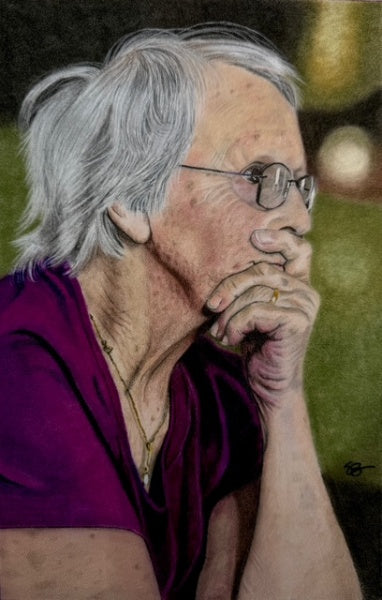
The Weight of the World, this piece portrays an elderly woman in quiet contemplation, conveying the emotional burdens we can carry without saying a word.
As an autistic artist, I’ve always experienced the world a little differently. I notice things that many people might overlook: the slightest shift in an expression, the tension around someone’s eyes, the way light changes the feeling of a face, or how a tiny movement can completely alter the mood of a portrait. Those subtle details are what draw me in, and they’ve become an important part of how I tell stories through my art.
I’ve never found words to be the easiest way to express how I feel. Emotions can be complex, layered, and sometimes difficult to explain, even when they’re incredibly strong. Art gives me another language, one that doesn’t rely on sentences or conversations. When I draw, I’m able to express thoughts and feelings that might otherwise stay inside.
Choosing a portrait subject isn’t about finding the most beautiful face or the most dramatic photograph. It’s about finding a connection.
Sometimes a person’s expression makes me stop scrolling. Other times it’s a quiet moment, a thoughtful gaze, or an emotion that seems to exist just beneath the surface. I don’t always know exactly why a reference photo speaks to me, but I trust that instinct. If it makes me feel something, there’s a good chance it will make someone else feel something too.
Before I ever put pencil to paper, I spend time looking. Really looking.
I wonder what the person might be thinking. I imagine the experiences that shaped them. I notice how the light falls across their face and how their posture changes the story. I don’t need to know the facts behind the photograph. What matters is the emotional connection I feel and the opportunity to create space for others to find their own connection.

Best Friends, celebrates the joy of lifelong friendship, capturing a moment of pure laughter, love, and connection. A reminder that the deepest bonds are often found in shared smiles.
That’s one of the things I love most about portraiture. Every viewer brings their own experiences with them. Someone may see hope where another sees sadness. One person might recognize strength, while someone else sees vulnerability. None of those interpretations are wrong. In fact, I hope they’re all different.
My goal has never been to tell people exactly what to feel.
Instead, I want to create portraits that invite people to pause, reflect, and discover their own story within the work.
“It’s about finding a connection.”
Realism is a huge part of my artistic practice because I want the viewer to believe the person in front of them could step off the page. But technical accuracy isn’t the destination—it’s simply the bridge that allows emotion to come through. Once the likeness is there, the real work begins.
The eyes often become the heart of every portrait. A tiny adjustment to a highlight or the curve of an eyelid can completely change how someone experiences the piece. Those details might seem insignificant on their own, but together they create an emotional presence that I hope people can feel.
Many of my portraits explore themes like resilience, quiet strength, reflection, joy, grief, and the emotions we often keep hidden behind everyday expressions. These subjects matter to me because they’re part of being human. We all carry stories that aren’t immediately visible, and I want my work to acknowledge that.
Quiet Concern, is a portrait of unspoken emotion, highlighting the hidden burden of men’s mental health and the importance of creating space for honesty, support, and healing.
Creating art has also helped me better understand myself. As an autistic person, I sometimes process emotions differently or need more time to make sense of them. I’ve realized that drawing isn’t just something I do, it’s part of how I think, reflect, and communicate. There have been many times when I didn’t fully understand what I was feeling until I saw it emerging in a portrait.
When someone tells me that one of my drawings reminds them of a loved one, makes them stop and think, or evokes an emotion they can’t quite explain, I know the portrait has done its job. Those moments mean more to me than hearing that my work is realistic or technically well done.
Art has the ability to create conversations without words.
That’s why I continue to return to portraits. Every face offers the possibility of connection. Every expression tells a story. Every drawing becomes another opportunity to say something that I might never be able to express aloud.
If my work encourages someone to pause for a moment, to feel seen, or to recognize a piece of themselves in the eyes of a stranger, then I’ve shared exactly what I set out to communicate.

Stacey Barge
Stacey Barge is a Calgary-based artist specializing in realistic coloured pencil portraits that capture both likeness and emotion. Her work explores the quiet stories behind each face, inviting viewers to form their own connections. An award-winning artist and President of the Calgary Chapter of the Federation of Canadian Artists, Stacey is passionate about creating artwork that is technically refined, emotionally engaging, and deeply personal.
Facebook: Stacey Barge Art
www.facebook.com/staceybargeart